Kickoff Diplomacy: Germany’s Ambassador to Ecuador on the Beautiful Game and the Art of Connection
Interview • Quito, Ecuador • January 2026
Ambassador Jens Peter Lütkenherm reflects on a life in diplomacy, his love of the beautiful game, and what it means to find home in a country of extraordinary diversity.
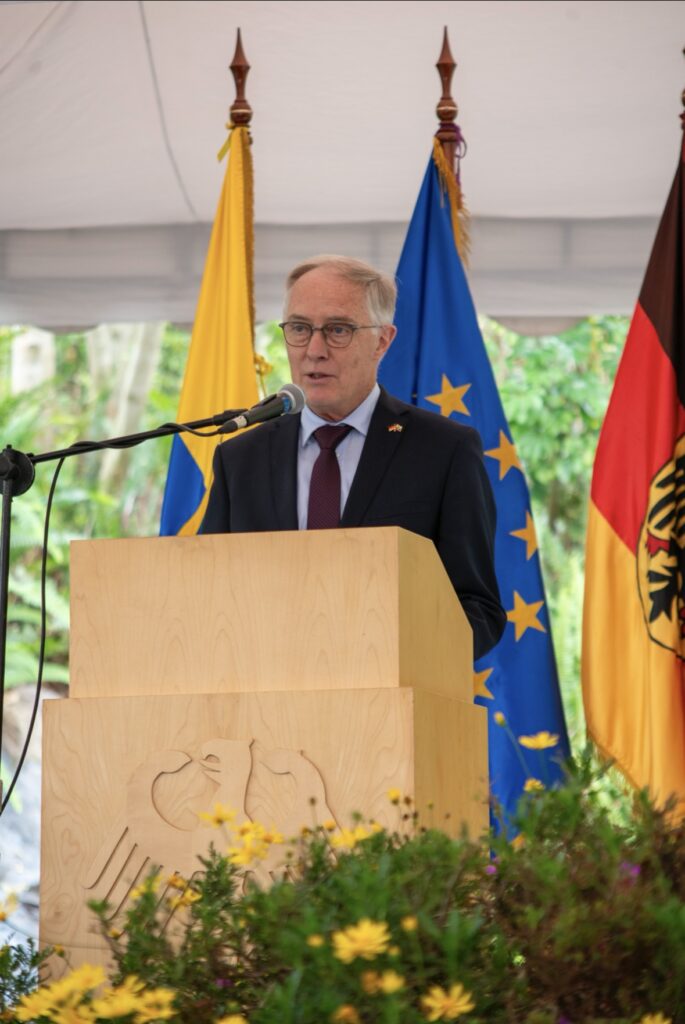
Jens Peter Lütkenherm has spent the better part of four decades representing Germany across five continents. From the consulate halls of San Francisco to the charged streets of Jerusalem, from the diplomatic corridors of Warsaw to the tropical heat of Laos, his career reads like an atlas of the modern world. Now, as ambassador to Ecuador, he finds himself in perhaps his most personally resonant posting yet.
“I was always interested in so many different things and countries in the world,” he tells me, seated in his office at the Quito embassy. You can say I’m really a generalist."
It’s a word he uses without apology, and with evident pride and a sense of humor.
THE MAKING OF A DIPLOMAT
The path to diplomacy was not his first choice. After studying history and political sciences, Lütkenherm’s initial ambition was journalism. He briefly pursued it. But an opening at Germany’s Academy of the Foreign Service changed everything. In 1988, he entered the diplomatic corps — and never looked back.
The early years brought postings that would shape anyone’s worldview: the high-energy consulate work in California, the weighty responsibility of serving near the Israeli-Palestinian conflict, the political complexity of post-communist Poland. “Two of my children were born in Jerusalem,” he notes quietly — a reminder that behind every diplomatic appointment is a family navigating the world alongside a career.
“Soccer can be a very powerful diplomatic tool — it brings people together all over the world, maybe more than anything else we have.” — Ambassador Jens Peter Lütkenherm
ON ECUADOR
When asked what has surprised him most about his current posting, the ambassador doesn’t hesitate. It’s the diversity. Not merely the sweeping landscape — the Andes, the Amazon, the Pacific coast, the Galapagos — but the living diversity of its people.
“The people in the mountains are different from the people on the coast,” he observes. “You have very different communities in this country — beautiful cities, each with their very own tradition and culture.”
It’s the kind of observation that only comes from genuine curiosity, the willingness to travel slowly and look closely.
Even the food has become a source of wonder. The omnipresence of rice on Ecuadorian tables initially surprised his household. “In Chile, it’s totally different,” he notes with a smile, drawing on a lifetime of comparative experience across South America. Now, he’s an enthusiastic convert to Quito’s restaurant scene, where Peruvian culinary influence has added yet another layer to an already rich table.
THE DIPLOMAT WHO PLAYS
What sets this particular ambassador apart — and what made our interview crackle with unexpected energy — is his relationship with football. Lütkenherm is not merely a fan. He has been a competitive player for most of his adult life.
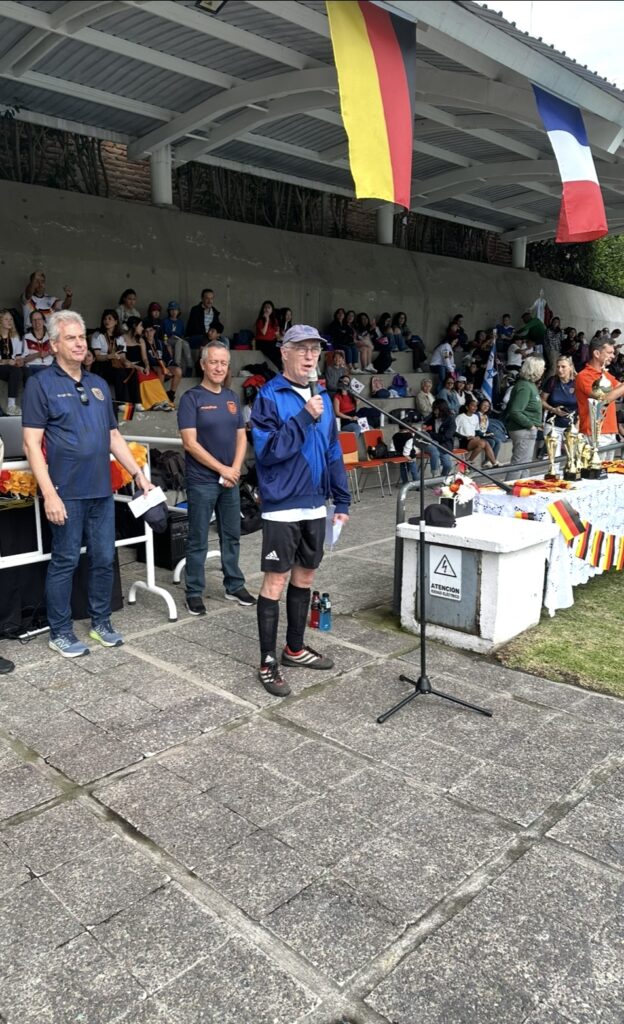
“Three times per week, training — and then one game per week. It was quite serious.” As a young man, he played at a competitive level. As a student, he managed university tournament teams. As a diplomat, he found pitches in Warsaw, Santiago and even Vientiane — playing in Laos when he was already past 60, in temperatures he describes with a laugh as “not easy.”
The timing of his Ecuadorian posting could not be more fitting. Germany and Ecuador are set to face each other in the group stage of the 2026 FIFA World Cup — a tournament historic in its own right, spanning the United States, Canada and Mexico for the first time.
“When I learned the third game of the first round is Germany versus Ecuador,” he says, eyes brightening, “I was very excited. It’s the best that could happen for me.”
Plans are underway to host a public event at the residence or at a venue that can accommodate the expected crowds. The ambassador is clear about one thing: he will watch the game together with people, Germans living in Ecuador and Ecuadorians alike.
SOCCER AS DIPLOMACY
For a man who has spent his career finding ways to connect disparate peoples, football offers something uniquely powerful. “Soccer in this country is such an important part of everyday life,” he reflects. “And it’s kind of like in my country.” The shared grammar of the sport — the same rules, the same passions, the same heartbreaks — becomes a ready-made bridge across language and culture.
Asked about Germany’s prospects, he is measured, the diplomat in him careful not to overcommit. He sees the team’s strength in its collective rather than its stars. “Maybe we don’t have the big international stars like some other nations,” he acknowledges, “but we have a large team of very strong players.” He’s confident they’ll advance past the group stage — a modest redemption after recent World Cup disappointments.
His closing message, though, is larger than any result. “The players on the field, they are no enemies. They are competitors. It’s so important that the game goes in a fair way. A good game.” He pauses. “And then of course — I hope Germany will win.”
Filmed in Quito, Ecuador.
Director's Note
This interview was filmed earlier in the year in Quito, Ecuador, at office of the German Ambassador. What struck me most during our time together was the Ambassador’s genuine warmth and his remarkable ability to speak about diplomacy not as statecraft, but as human connection.