Consul General Gicela Andrade Valens: Somos Fútbol — Ecuador Identity, and NJNY Global Tournament 2026
Interview • NYC, NY • May 2026
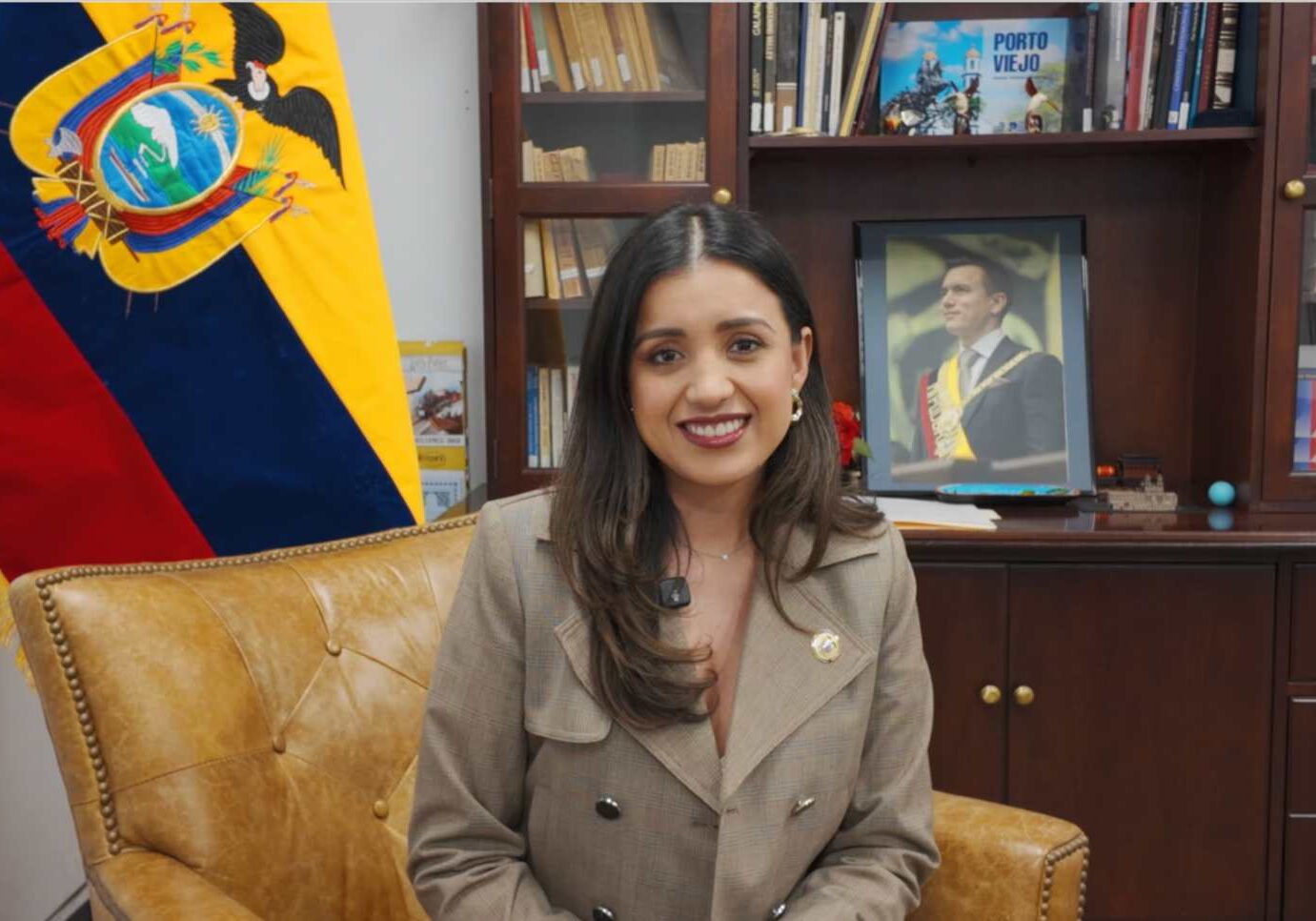
Gicela Andrade Valens on what it means to represent Ecuador when its national team plays in the historic 2026 World Cup at MetLife Stadium.
There are personal stakes for me in this interview. I was born in Quito, and though I have lived my whole life in the United States, I carry a deep, tender love for Ecuador. It has always been the underdog of soccer — a country that didn't make it to the World Cup until 2002, and when it finally did, it arrived on the shoulders of players from El Valle del Chota, an Afro-Ecuadorian farming community whose sons turned their longing for a better life into something the whole world watched. I produced DreamTown, directed by Betty Bastidas, featuring three of those players — their individual journeys of defiance against poverty, in pursuit of a dream. Genuine, human-centered stories that never left me.
So, seeing Ecuador back on the world stage in 2026 — and sitting across from the woman appointed to represent that country in New York — made this interview something more than a conversation. It was poetic.
Gicela Andrade Valens took up her post as Consul General of Ecuador in New York in November 2025, arriving in a city she describes as "very welcoming, full of Ecuadorians who are happy to be here, who have worked and contributed their whole lives to the construction of this beautiful city." She speaks about the community with the warmth of someone who recognizes herself in them — their resilience, their pride, their unbreakable sense of identity even when far from home.
"It is a vibrant community, a hardworking community — and above all, I highlight that sense of belonging that always accompanies them. Wherever they go, they carry Ecuador in their hearts."
A Country That Never Leaves You
To understand why Ecuadorians love their country the way they — we — do, fiercely, tenderly, without apology, you have to understand what Ecuador actually is. Andrade Valens puts it plainly: "Ecuador is a multiethnic, pluricultural country known as the country of the four worlds — the Andes, the Coast, the Galápagos, and the Amazon." She is not reciting a tourism brochure. She is describing a place of staggering biological and cultural richness, a country where the food alone tells an extraordinary story. "We have delicious dishes, incredible gastronomy — encebollado, llapingachos, our fruits, our flowers. Our biodiversity is infinite."
It is the kind of country that, once you've left it, never really leaves you. And for the Ecuadorian community in New York — hundreds of thousands strong, spread across the boroughs and into New Jersey — the World Cup is not merely a sporting event. It is a reunion with everything they carry inside.
From El Valle del Chota to the World Stage — and Back Again
Ecuador first qualified for the FIFA World Cup in 2002 — a moment that stopped a nation. The players who made it happen were extraordinary: a generation shaped in large part by El Valle del Chota, an impoverished Afro-Ecuadorian community in the Andean highlands whose sons carried an entire country's dream onto the world stage. Those men are still celebrated. They always will be. What they started, however, has become something none of them could have fully imagined.
Two decades on, Ecuador enters 2026 as a different proposition entirely. With Paris Saint-Germain's Willian Pacho and Bayer Leverkusen's Piero Hincapié marshaling the back line and Chelsea's Moisés Caicedo shielding the defense just ahead, Ecuador proved to be the toughest team to break down in CONMEBOL World Cup qualifying — finishing second behind reigning champions Argentina, conceding only five goals across 18 matches, the fewest of any side.
At the center of it all is Moisés Caicedo, signed by Chelsea for a reported £115 million (US$146 million), the highest-ever transfer fee in British soccer — a number that announced to the world exactly how Ecuador's talent is now valued. Around him: Kendry Páez, Chelsea's teenage prodigy; Willian Pacho of PSG; Piero Hincapié of Bayer Leverkusen; Pervis Estupiñán of AC Milan. Up front, captain Enner Valencia — Ecuador's all-time leading scorer — leads with hard-won experience, while Gonzalo Plata of Flamengo brings the unpredictability this team needs.
Sports Illustrated FC is among the outlets keeping an eye on Ecuador, ranking La Tricolor among the top dark-horse contenders for 2026 — noting that no one has beaten them since the start of 2025, with the Netherlands and Morocco both held to draws in March. SI's verdict: "This may be Ecuador's finest-ever team." Drawn into Group E alongside Germany, Côte d'Ivoire, and Curaçao, this golden generation genuinely believes it can guide the country past the group stage for the first time since 2006.
The underdog years are not forgotten. They are the foundation. This team is what those years built — and the world is watching.
Andrade Valens feels it too. "Ecuador always supports its national team — it lives through, vibrates through soccer," she says. "Since 2002, I remember that feeling. It was unforgettable. It unites us as a country and identifies us wherever we go."
"I have complete faith in my team, in my boys. I know they are going to give their best in every match — and that Ecuadorian talent is going to show."
The Ball as a Bridge
For Andrade Valens, the World Cup is never only about what happens on the pitch. "Sports diplomacy demonstrates that through soccer, people come together, cultures are promoted, and relationships between countries are strengthened — beyond whatever political differences may exist," she says. "We are not only talking about soccer. We are talking about a feeling of identity, of brotherhood."
It is a sentiment that echoes across this entire series — from Mexico's Head Consul in New Jersey to Germany's Ambassador in Ecuador. Soccer builds bridges that diplomacy alone cannot. And frankly, no amount of formal treaty language has ever moved a crowd the way a last-minute goal does.
For Ecuador — recently awarded "Destination of the Year" at the PATWA International Travel Awards at ITB Berlin 2026, the world's most important tourism fair, and crowned Wanderlust Destination of 2025 by one of the world's most respected travel publications — the World Cup arrives as the ultimate global stage. From world-class eco-lodges nestled in the cloud forest to the untouched wonders of the Galápagos, Ecuador is no longer a secret. "Every time Ecuador plays, it is placed before the eyes of the entire world," Andrade Valens says, "which helps us position our image, our culture, and our tourism at a global level." The world is finally catching up to what Ecuadorians have always known.
"We are not only talking about soccer. We are talking about a feeling of identity, of brotherhood — and what helps promote the best of our countries."
The Consulate Is Ready — And So Is the Table
As the tournament approaches, the Consulate General of Ecuador in New York is quietly doing the work that diplomacy actually requires — not speeches, but logistics. "We will have an emergency line available 24 hours a day, 7 days a week, for accidents, hospitalizations, emergency passports — anything that requires our immediate attention," Andrade Valens says. And if you've ever lost a passport abroad, you know which emergency feels worse.
When Ecuador's matches are on, the consulate is working to create spaces where the community can watch together — in celebration, in family unity, in full-throated support for La Tricolor. The table, she promises, will be worthy of the occasion: encebollado, ceviche, arroz con menestra, the flavors of the coast, the sierra, the Amazon. All of it. For everyone who comes.
"We want to guarantee that our compatriots can enjoy this important event in a positive and safe way."
For the Players, From a Nation
When asked what she wants to say directly to the players, Andrade Valens does not hesitate. Her words are for the team — but they belong to every Ecuadorian watching from anywhere in the world:
"We are with you. We are very proud of everything you have achieved, of all the effort and sacrifice that has made it possible for us to be at the World Cup. An entire country supports you, and we know you will carry the name of Ecuador to the highest place."
Director's Note
There is a particular kind of love I will always carry for where I was born. Yes, the United States is my home and has given me extraordinary opportunities — but Ecuador remains that special beat in my heart that keeps me warm.
I produced DreamTown, a film about three players from El Valle del Chota — the Afro-Ecuadorian community whose sons gave Ecuador its first World Cup in 2002. Their story taught me what soccer can mean when it carries something larger than itself — a community's dreams, a country's dignity, a generation's hunger for the world to finally see them.
Sitting with Gicela Andrade Valens, I felt that same current. She is a diplomat who speaks about soccer the way you speak about something sacred — not with reverence exactly, but with the quiet certainty that it matters. That it connects. That when Ecuador takes the field in 2026, something more than a game is happening.
Caicedo, Páez, Pacho, Valencia, and the rest — they are what those years built.
Vamos, Ecuador. Siempre.
— Giovanna Aguilar
