The Beautiful Game as Diplomacy: Mexico’s Head Consul on Fútbol and 2026 | Kicking It to 2026
Interview • New Brunswick, NJ • March 2026
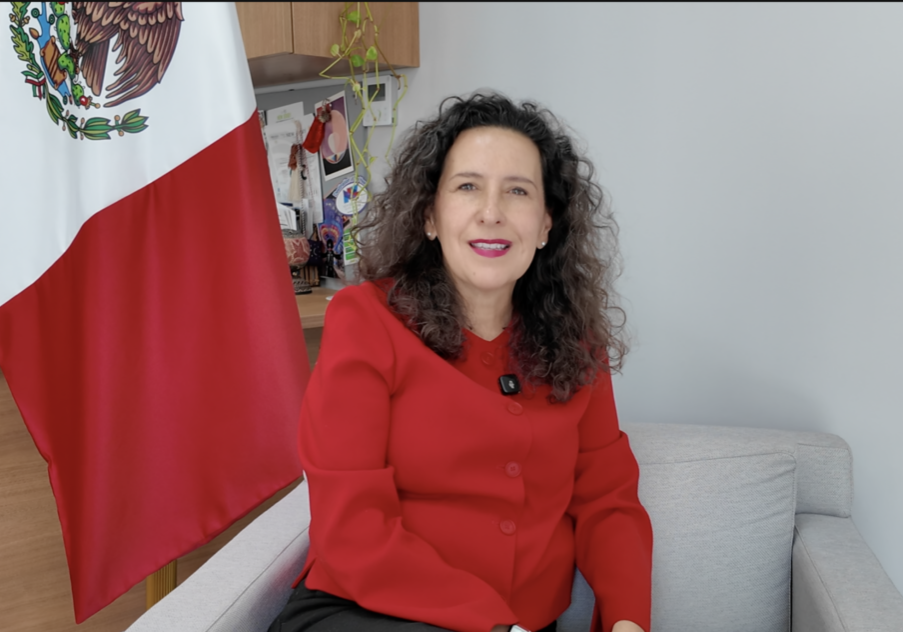
Consul Mariana Díaz-Nagore on fútbol, community, and why the 2026 tournament is about far more than the final score.
In Mexico, they don't call it soccer. They call it fútbol — and the distinction matters more than it might seem.
When Mariana Díaz-Nagore, Head Consul of Mexico at the Consulate of New Brunswick, speaks about her country's relationship with the sport, she isn't describing a pastime. She is describing an identity. "Over 60% of Mexicans prefer fútbol over any other sport," she offers. "That tells you about the passion."
Díaz-Nagore leads a consulate of 29 people serving one of New Jersey's most vibrant and entrepreneurially active immigrant communities — one that is counting down the days to what promises to be the most consequential sporting event on North American soil in a generation.
A COMMUNITY BUILT TO LAST
"You can see a little piece of Mexico everywhere you go," she says of New Jersey's Mexican community, drawing a vivid geography of belonging — Passaic, French Street in New Brunswick, block after block of businesses built by immigrants who arrived with ambition and stayed to build something permanent. It is this community that she has spent two years cultivating relationships with, and it is this community that she is now mobilizing around the tournament.
"As soon as the World Cup is over, people start saving for the next one." — Mariana Díaz-Nagore, Head Consul of Mexico, New Brunswick
THIRD TIME HOST — AND MEXICO IS READY
No country has hosted the global tournament three times. Mexico will, in 2026 — having done so first in 1970 and again in 1986. The numbers alone tell a story. When the 2022 tournament was held in Qatar — a journey of thousands of miles and significant expense — nearly 100,000 Mexicans made the trip. For 2026, with games hosted across the border, that number is expected to surge. Mexico will host 13 matches across three cities, with five of them — including the inaugural game, Mexico against South Africa — played at the Estadio Azteca in Mexico City. More than six million visitors are anticipated.
Díaz-Nagore remembers the last time Mexico held the tournament. She was thirteen years old, a middle schooler in Mexico City. "Everything in Mexico City was about the games," she recalls.
"Any time there was a game, everything stopped because everybody was watching." She did not have a ticket to the stadium, but the stadium came to her — through the television, through the streets, through the electricity in the air of a city that knew it was living through something historic.
"Every time the national team played, it was just magic." — Mariana Díaz-Nagore
FÚTBOL AS DIPLOMATIC CURRENCY
The 2026 tournament — the first ever co-hosted by three nations, the United States, Canada and Mexico — arrives not merely as a competition but as a statement. For Díaz-Nagore, the diplomatic dimensions of the sport are inseparable from the cultural ones. "This is an opportunity to showcase Mexico — gastronomy, tourism, investment," she notes. A tournament that unfolds across three countries is also a demonstration of integration, of shared purpose, of a North America that functions as a cohesive and capable host to the world.
"When Mexico is playing, we are going to see how the Mexican community unites. And that's when diplomacy comes into place." — Mariana Díaz-Nagore
WHAT THE CONSULATE IS DOING RIGHT NOW
From the consul's perspective, the practical work of the tournament is already underway. Díaz-Nagore describes a framework of what she calls "preventive protection" — ensuring that the wave of Mexican visitors arriving for games in New Jersey knows what they need before they land: a valid visa, a passport with at least six months of validity, travel insurance, and registration with Mexico's SIRME system. The consulate's 24/7 emergency line will be publicized through social media, fan festivals, and watch parties. Lost passport, an arrest, a hospitalization — the consulate exists to be a resource in those moments, not just an administrative office. New Jersey: 732-619-0566
ON THE TABLE: WHAT A MEXICAN WATCH PARTY LOOKS LIKE
Ask Díaz-Nagore what belongs on the table and she doesn't hesitate. "Guacamole — that's something you can't miss at a Mexican party. Quesadillas, sopes, tacos dorados, salsas, totopos. It's going to be a feast." Ask her the Mexican word for "tailgating" and she corrects the premise, warmly. "We don't really have a tailgate. We would have a carne asada — but it happens more at homes than around the stadium." Fans become fanáticos. Soccer becomes fútbol. And somewhere between those translations lives the soul of what is about to unfold.
"Just to have these six weeks of matches in three countries — I think it's going to be an experience everybody will remember." — Mariana Díaz-Nagore
Director's Note
This interview was filmed in New Brunswick, New Jersey, at the Consulate of Mexico. What struck me most during our time with Consul Díaz-Nagore was the seamless way she moves between roles — diplomat, community builder, and passionate fan — without missing a beat. She speaks about fútbol the way she speaks about her work: with genuine conviction that the connections we build with one another, whether across a negotiating table or a stadium, are what endure long after the final whistle.
